Advances in theoretical chemistry, computational chemistry, materials science, physics, and supercomputers are making it practical to consider first principles (de novo) predictions of important systems and processes in the Chemical, Biological, and Materials Sciences. Our approach is to build a hierarchy of models each based on the results of more fundamental methods but coarsened to make practical the consideration of much larger length and time scales. Connecting this multi-paradigm multi-scale hierarchy back to quantum mechanics enables the application of first principles to the coarse levels essential for practical simulations of complex systems.
We will highlight some recent advances in methodology such as:
which we will illustrate with recent applications to Energy, Environment, Nanotechnology, Water, and Pharma selected from:
The morning lecture (1.5 hours) will focus on the methods while the afternoon lecture (1.5 hours will focus on applications.
Para maiores informações, entre em contato com Prof. Andre Gustavo Barbosa - andre@vm.uff.br
An introduction to the molecular basis of heterogeneous catalytic reactions will be given. Sabatier principle and Bronsted-Evans -Polanyi relations will be introduced. It will appear that structure sensitivity of elementary reaction steps can be explained by the Bond-Order-principle. The class of structure dependence found depends on the type of chemical bond to be activated. We will apply these concepts to steam reforming and the Fischer-Tropsch reaction. We will show how from quantum-chemically computed data a kinetic scheme can be devised. Kinetics turns out to sensitively depend on changes in the adsorbate overlayer during reaction. In the introduction to zeolite catalysis it will be explained that structure dependence of chemical reactivity depends on the balance of reduced entropy of adsorption and increased interaction energy of reactant as a function of channel dimension.
Para maiores informações, entre em contato com Prof. Itamar Borges - itamar@ime.eb.br
The topic of this seminar are multireference calculations on interesting biradical and multiradical systems using the multiconfiguration self consistent field (MCSCF), multireference configuration interaction (MRCI) and multireference averaged quadratic coupled cluster (MR-AQCC) methods available in the program system COLUMBUS. Two examples will be discussed. The first one is a biradical structure
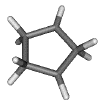
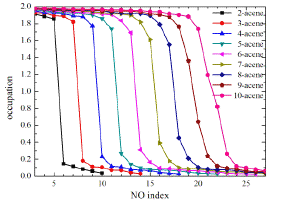
derived from the thermal deazetization of a diazabicyclo[2.2.1]hept-2-ene, which leads to an interesting series of reactions and great challenges for interpretations. Secondly, the radical character of polyacenes and of graphene nanoflakes will be discussed. As an example, the figure below shows the evolution of the NO occupations with acene size and their increasing deviation from closed shell occupation.
In the first part of this course an overview of the use of the computational methods and about results will be given. In the second part selected calculations will be performed online in a computer lab.
Para maiores informações, entre em contato com Prof. Thiago Cardozo - thiago.dfq@iq.ufrj.br